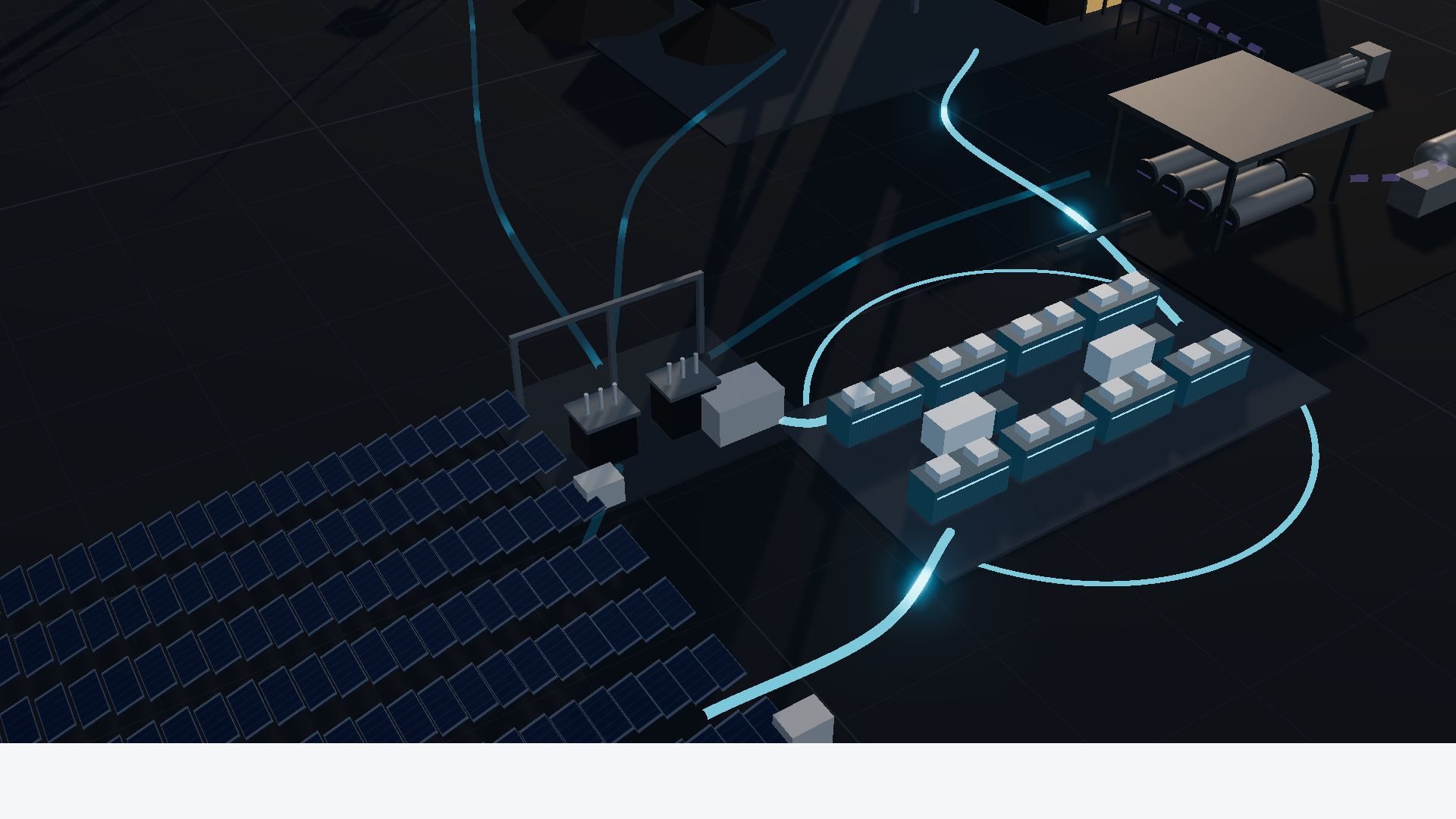
Systems · Industrial battery storage
The right power. For the right duration.
Industrial battery storage can shift electricity between periods and support selected site-energy requirements. A useful battery energy storage system (BESS) specification begins with the application, required power, usable energy and operating conditions. KyperX welcomes assessment and supply enquiries for industrial and utility-scale systems.
Applications
Give the battery a defined job.
-
01
Load shifting
Investigate charging and discharge opportunities against site demand and electricity costs.
-
02
Renewable integration
Assess how storage could change the timing of usable generation.
-
03
Peak-demand management
Evaluate a defined site's demand profile and tariff.
-
04
Operational support
Investigate a specific continuity or power-system requirement and the additional infrastructure it would need. Backup, islanding and uninterrupted supply require an electrical arrangement and controls designed for that duty; they should not be assumed from the battery rating alone.
Industrial battery systems: supply enquiries welcome.
We welcome requests for containerised BESS equipment and integrated project proposals. The starting point is your application. We can discuss requirements, investigate manufacturer options and define the equipment and delivery scope to be evaluated.
Equipment availability, warranty, installation and commissioning responsibilities are confirmed in the project proposal.
- 01
Requirements assessment
Establish the duty, information needs and preliminary power/energy criteria.
- 02
Equipment sourcing
Investigate suitable systems, technical documentation and supplier conditions.
- 03
Integrated proposal
Define equipment, electrical interfaces and the specialist work required for the site.
Technical explanation
Power, energy and duration are different requirements.
Power, measured in MW, describes the rate of charging or discharge. Usable energy, measured in MWh, describes how much can be delivered within the specified operating limits. Duration connects the two at a stated power level. Recharge opportunities, losses, degradation and the site connection also influence the duty a system can sustain.
Read: Battery power, energy and duration- Duration at constant power
- 2 hours
Duration = usable energy ÷ discharge power
Illustrative constant-power relationship; system capability and operating limits must be verified.
Compare scope
Compare the system behind the specification.
Compare power and usable energy at the same measurement boundary and under stated operating conditions. Include efficiency, auxiliary consumption, degradation, availability and warranty limits. Identify equipment, controls, site works, connection, commissioning and maintenance as included, excluded or supplied by others.
| Proposal item | Boundary | Notes for comparison |
|---|---|---|
| Usable energy and rated power | Equipment performance | Stated separately; MWh and MW are different requirements. |
| Environmental conditions | Equipment performance | The conditions under which performance is specified. |
| Conversion equipment | Equipment scope | Included, excluded or supplied by others. |
| Controls | Equipment scope | Included, excluded or supplied by others. |
| Safety evidence | Evidence | Documentation provided for the specific product. |
| Warranty terms | Commercial terms | Warranty provider and conditions. |
| Maintenance responsibilities | Commercial terms | Who maintains the system, and on what basis. |
| Site works | Delivery scope | Distinguished from equipment supply. |
| Grid connection | Delivery scope | Distinguished from equipment supply. |
| Commissioning | Delivery scope | Distinguished from equipment supply. |
Connected systems
Connected to industry. Distinct from manufacturing research.
Our broader program has investigated battery use under industrial-load and electricity-price scenarios. Separate research has examined LFP cell-manufacturing processes. Supplying a manufacturer system and developing a battery-manufacturing process are different activities, with different evidence and responsibilities.
Questions customers ask.
Can I enquire without knowing the required MWh?
Yes. Share the application and any available load or tariff information.
Are these KyperX-manufactured batteries?
This supply-enquiry pathway concerns equipment options to be evaluated for the project. The manufacturing-research program is presented separately.
Can a battery guarantee lower electricity costs?
The outcome depends on the application, costs, tariffs and operating constraints. Assessment is required before a project-specific conclusion.